Launch offer — valid today only

The Easiest Way to Learn Psychology Explained with Pictures

Neurons, memory, Piaget, Milgram, disorders: the course is huge and the terms blur together. Here every idea fits on one page, with a drawing that does the explaining. 82 illustrated pages for AP® Psychology and Intro Psych. 82 illustrated pages.

I WANT TO LEARN IT THE EASY WAY

🔒 Secure checkout · PDF by email · 30-day guarantee

One topic per pagethe drawing teaches you the theory and the text backs it up
82 illustrated pages6 parts, from the seven perspectives to therapy, plus a last-minute review
Up-to-date sourcesCollege Board AP® Psychology CED (2024-25), APA and DSM-5-TR

This Is What the Pages You Will Study Look Like

One topic per page, the drawing that shows you how it works and the boxes with what you need to know:

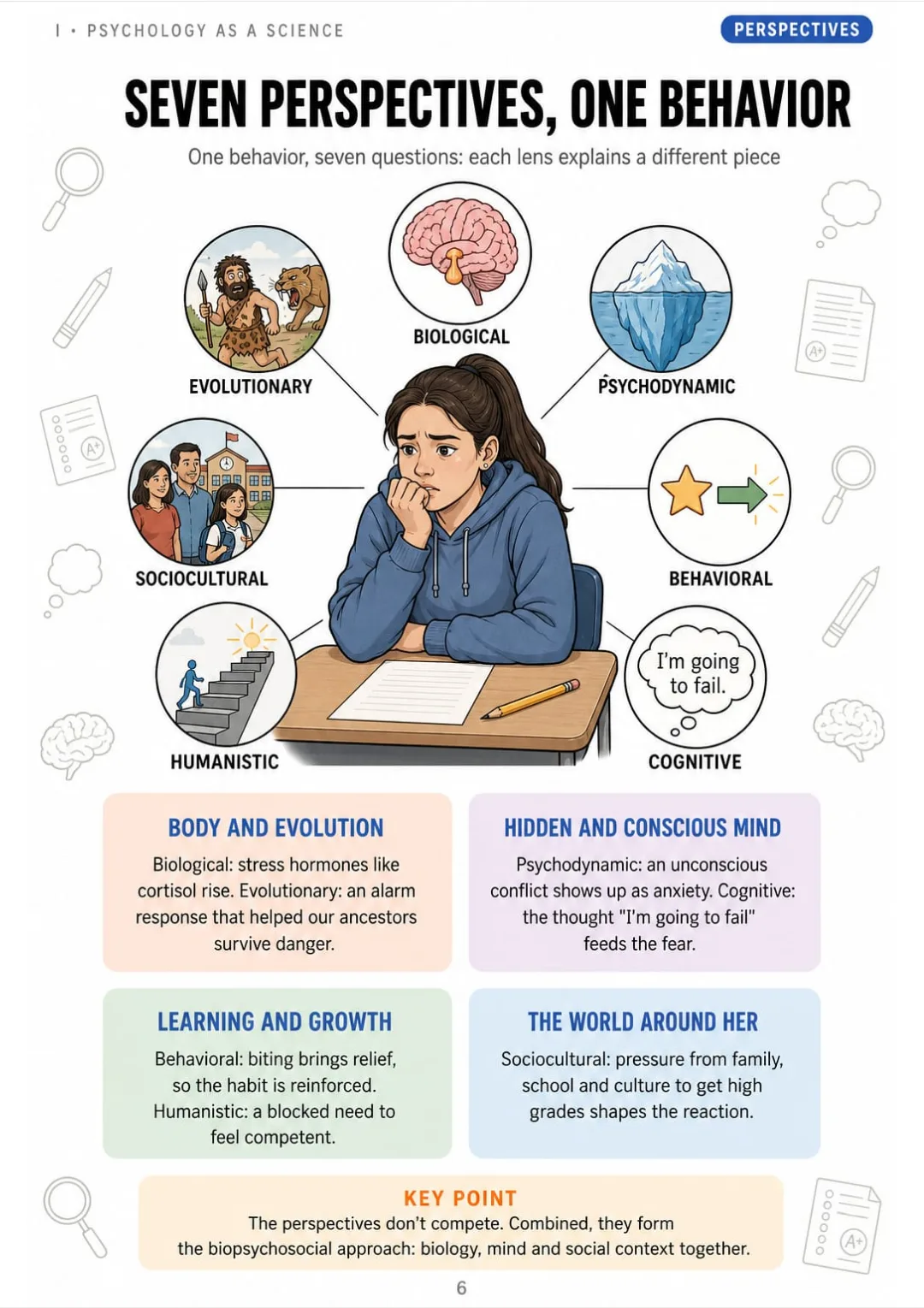
Seven perspectives drawn around one behavior: biological, evolutionary, psychodynamic, behavioral, cognitive, humanistic, sociocultural.
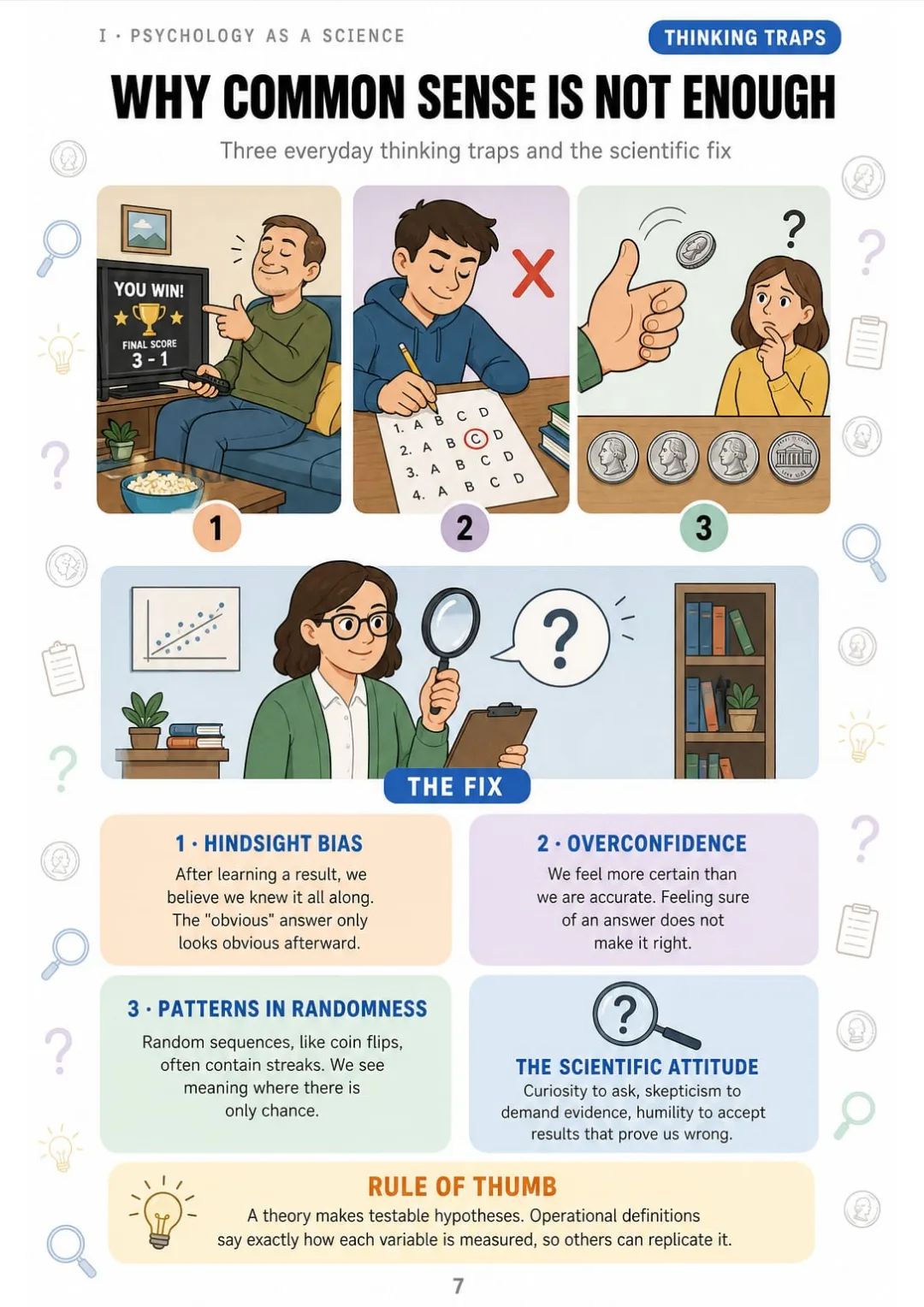
Hindsight bias, overconfidence and random patterns drawn, plus curiosity, skepticism and humility as the fix.
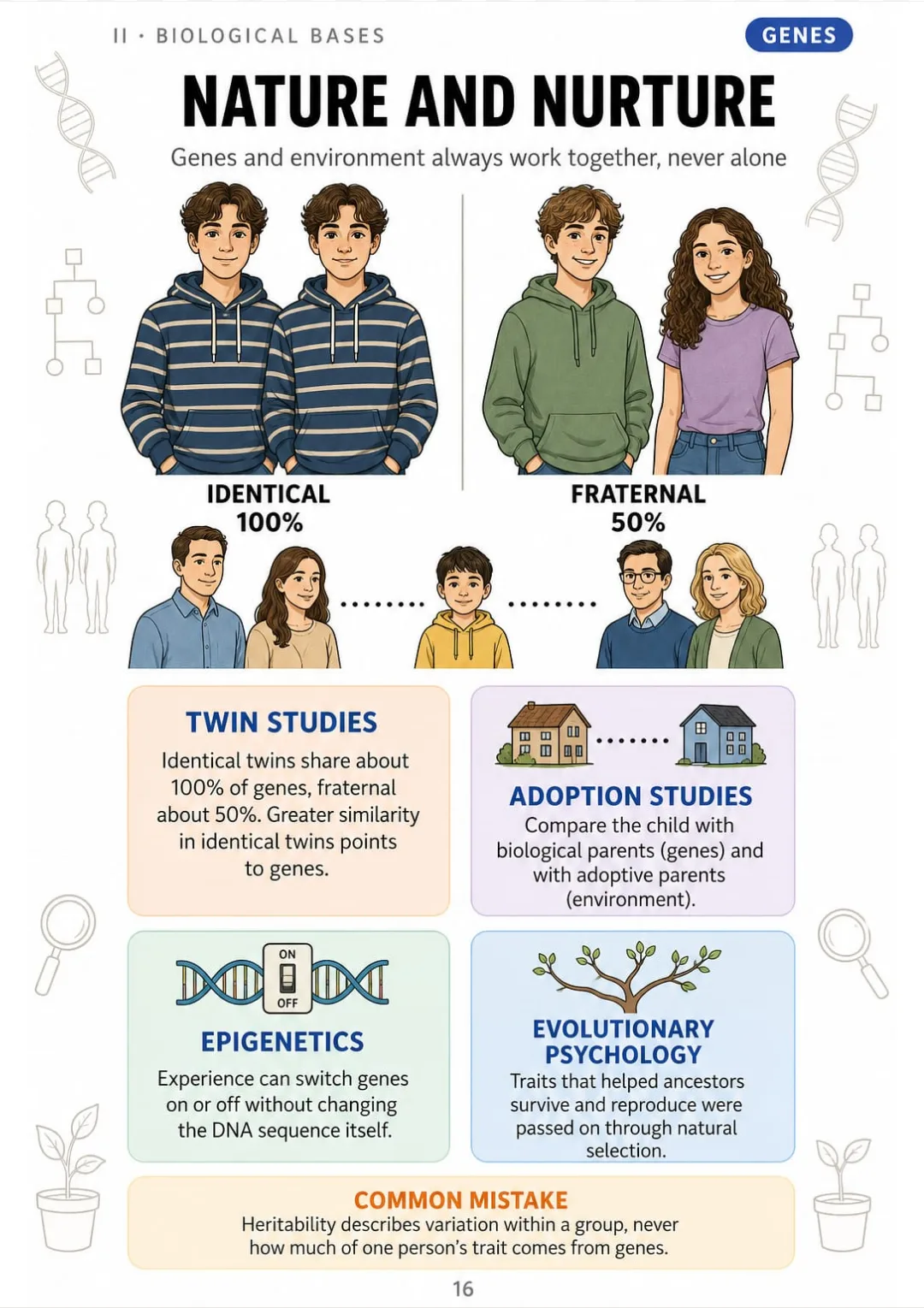
Identical twins about 100%, fraternal about 50%: what twin studies really measure.
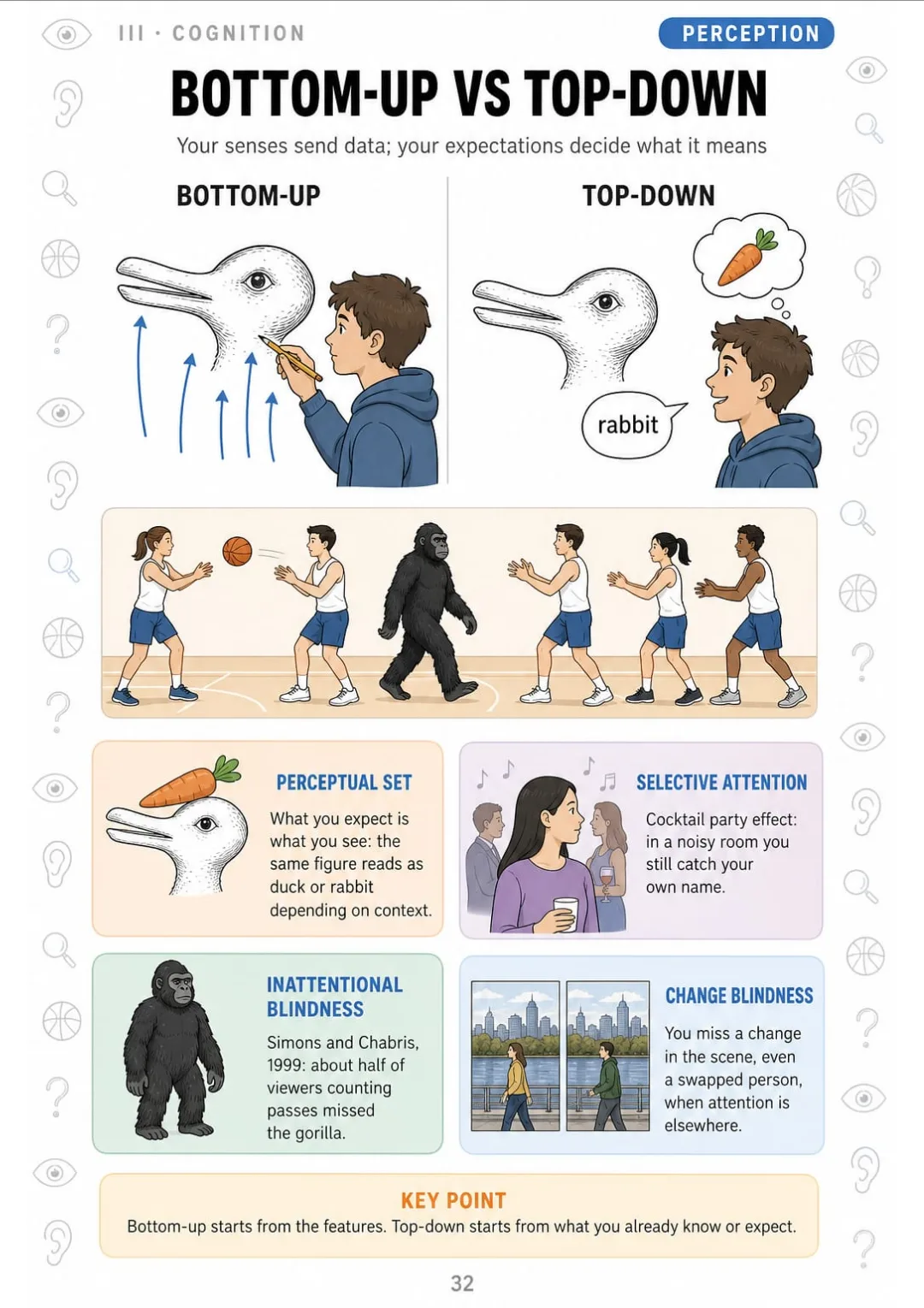
Bottom-up vs top-down, plus the gorilla nobody saw (Simons and Chabris, 1999)
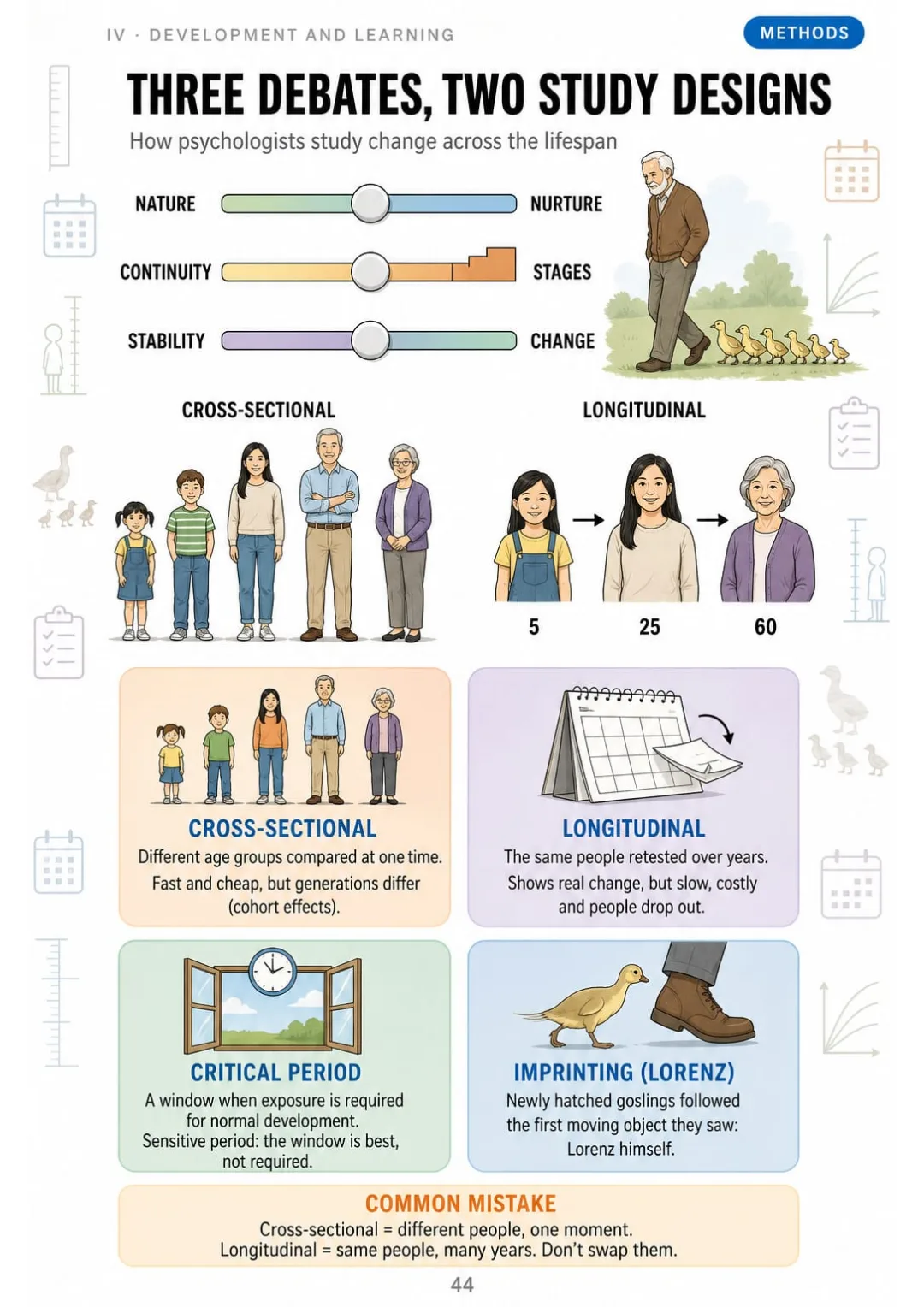
Cross-sectional compares ages at once; longitudinal follows the same people for years.
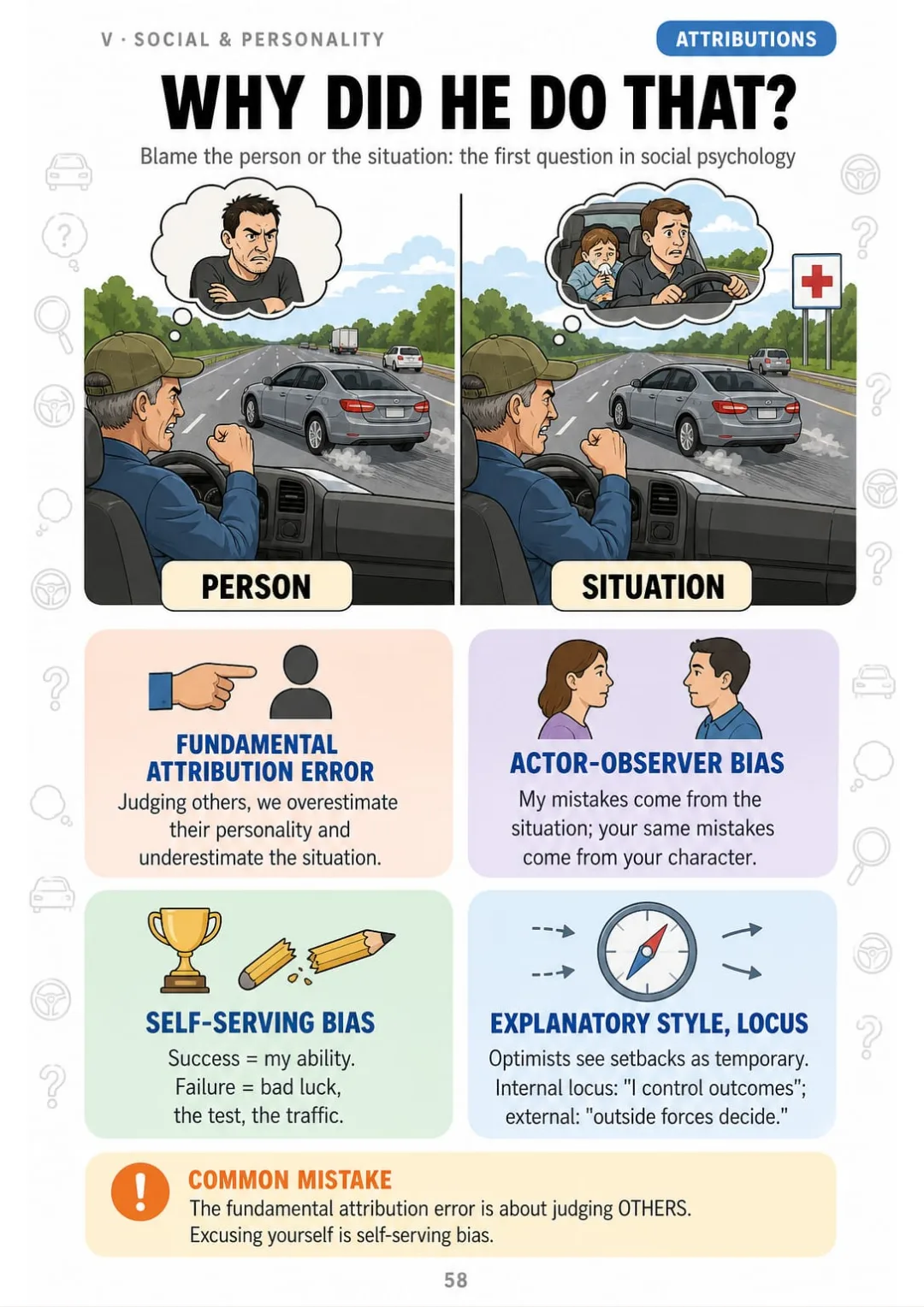
Dispositional vs situational: one driver, two stories, three classic biases.
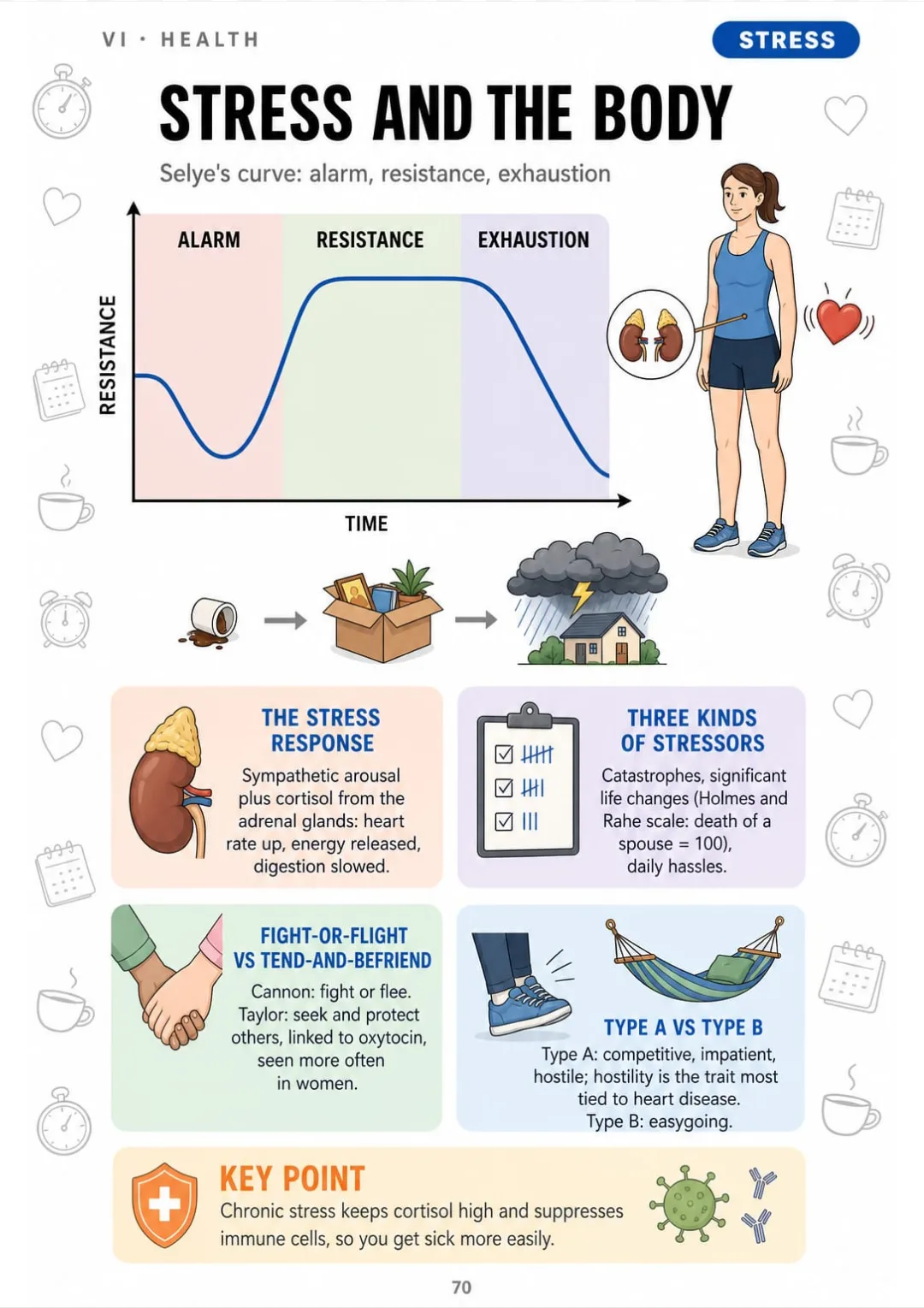
Selye's general adaptation syndrome drawn as one curve, with cortisol and Type A vs B
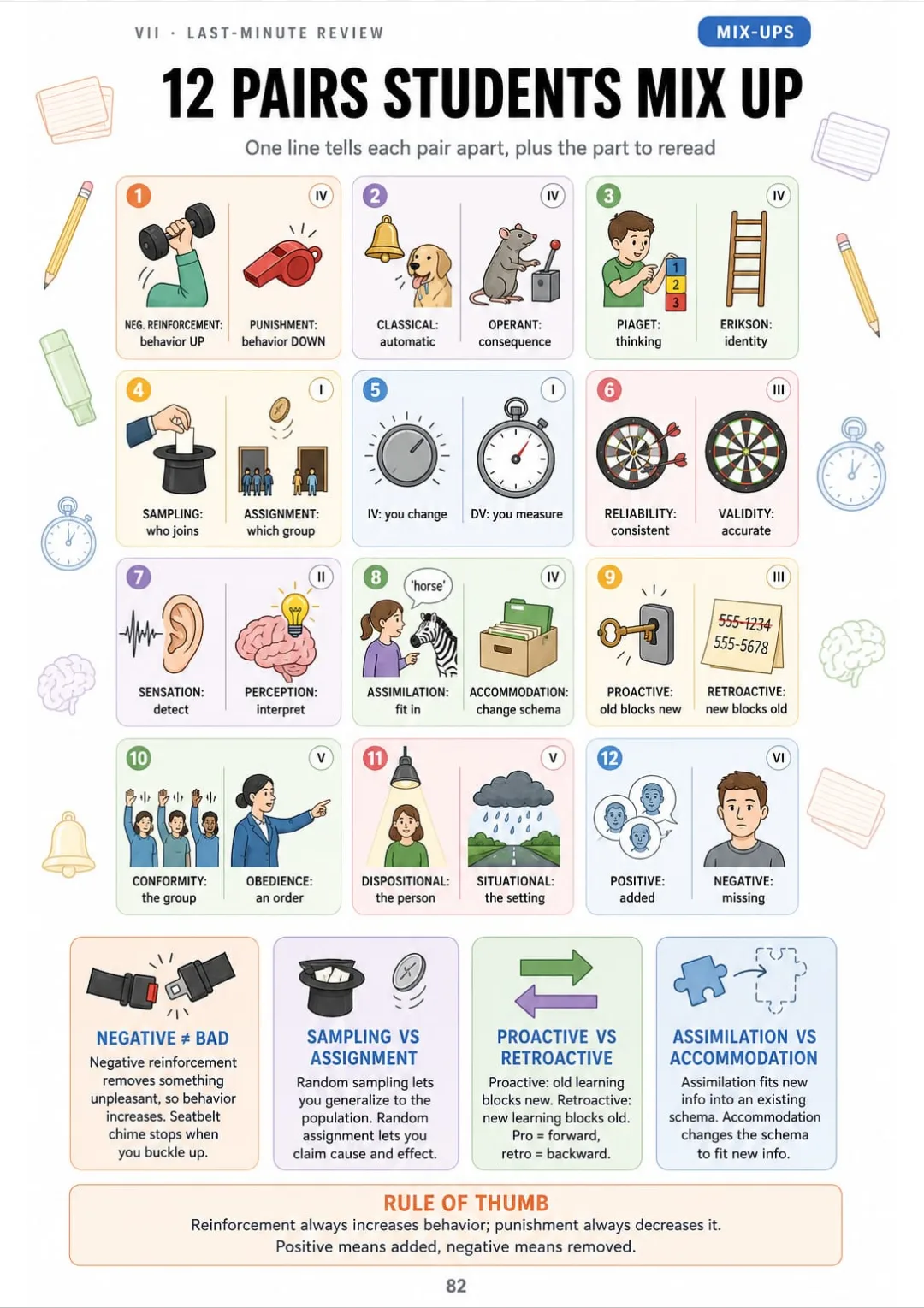
12 confusing pairs, side by side: negative reinforcement vs punishment, IV vs DV, reliability vs validity and more

Swipe to see more →

These are real pages from the book. The table of contents is the full one: 7 parts and 77 topics.

It's Not That You Have a Bad Memory. It's That Nobody Put It in Order for You.

You've read the nature and nurture section three times. You close the textbook...

...and you can't say what a twin study actually measures. It was just one line after another.

Identical twins about 100%, fraternal about 50%: what twin studies really measure.

Here nature and nurture is one page: identical twins share about 100% of their genes, fraternal twins about 50%, drawn side by side, with what the gap between them tells you.

And on the pages next to it, every topic gets its own: the neuron, the four lobes, Piaget's stages, operant conditioning and the Big Five.

First you understand why it works that way. Then the names stick on their own.

SEE THE DIFFERENCE

Stop memorizing theories you can't picture:

THIS
  • Pages and pages of dense text
  • Theories and studies without a single drawing
  • On the exam, you don't know where to start
Although intuition may appear to provide reliable knowledge about behavior, a substantial body of research indicates that common sense is subject to systematic error. Hindsight bias, the tendency to believe, after learning an outcome, that one would have foreseen it, leads individuals to overestimate the predictability of events. Overconfidence further compounds this error, as people consistently judge their answers to be more accurate than they are. Moreover, humans readily perceive order in random sequences. Consequently, the scientific attitude, comprising curiosity, skepticism and humility, is considered essential to psychological inquiry.
FOR THIS
  • Every theory drawn
  • One topic per page, with the key facts in boxes
  • You remember it because you've seen it
Hindsight bias, overconfidence and random patterns drawn, plus curiosity, skepticism and humility as the fix.
CONTENTS

Take a Look at the 7 Parts and 77 Topics

Part 1 covers research methods and data, which the exam tests across every unit. Parts 2 to 6 follow the five units of the redesigned AP® course, in the same order: biological bases, cognition, development and learning, social psychology and personality, and mental and physical health. Then a last-minute review. 82 pages, all illustrated

IPsychology as a Science · pp. 6-15
  1. Seven perspectives, one behavior
  2. Why common sense is not enough
  3. Case studies, surveys and observation
  4. Correlation is not causation
  5. The experiment
  6. Samples, placebos and blind studies
  7. Describing data: center and spread
  8. The normal curve and what results mean
  9. Research ethics
  10. Review
IIBiological Bases of Behavior · pp. 16-31
  1. Nature and nurture
  2. The nervous system at a glance
  3. The neuron
  4. How a neuron fires
  5. Neurotransmitters and hormones
  6. Drugs and the synapse
  7. From the brainstem to the limbic system
  8. The four lobes of the cortex
  9. Two hemispheres and a changing brain
  10. Sleep stages and body clocks
  11. Why we sleep, why we dream
  12. Sensation: thresholds and adaptation
  13. Vision
  14. Hearing
  15. Smell, taste, touch and balance
  16. Review
IIICognition · pp. 32-43
  1. Perception: bottom-up and top-down
  2. Organizing what we see
  3. Concepts, schemas and shortcuts
  4. Decision traps and creativity
  5. Kinds of memory
  6. Three models of memory
  7. Encoding: getting it in
  8. Storing and retrieving
  9. Forgetting and false memories
  10. Intelligence: theories and tests
  11. Intelligence scores in context
  12. Review
IVDevelopment and Learning · pp. 44-57
  1. Themes and methods of development
  2. Growing bodies, from before birth to old age
  3. Piaget's four stages
  4. Vygotsky and the aging mind
  5. Language
  6. Attachment and parenting
  7. Erikson's eight stages
  8. Adolescence and identity
  9. Classical conditioning
  10. Fear, taste aversion and habituation
  11. Operant conditioning
  12. Shaping and schedules of reinforcement
  13. Learning by watching and thinking
  14. Review
VSocial Psychology and Personality · pp. 58-69
  1. Explaining behavior: attributions
  2. Stereotypes, prejudice and expectations
  3. Changing minds: dissonance and persuasion
  4. Conformity and obedience
  5. What groups do to us
  6. Helping, conflict and cooperation
  7. The psychodynamic view
  8. The humanistic and social-cognitive views
  9. Traits and the Big Five
  10. Motivation
  11. Emotion
  12. Review
VIMental and Physical Health · pp. 70-81
  1. Stress and the body
  2. Coping and positive psychology
  3. What makes a disorder
  4. Neurodevelopmental and schizophrenia spectrum disorders
  5. Depressive and bipolar disorders
  6. Anxiety disorders
  7. OCD, trauma and dissociation
  8. Eating and personality disorders
  9. Talk therapies
  10. Behavior therapies, groups and hypnosis
  11. Medication, brain stimulation and care today
  12. Review
VIILast-minute review · p. 82
  1. Last-minute review: pairs students mix up

What If Every Topic Fit on a Single Page?

What if every topic fit on a single page?

Instead of rereading half a page on operant conditioning without being able to picture it...

...you open the page and find reinforcement and punishment in one drawn grid: add something or take it away, make the behavior go up or go down.

Cross-sectional compares ages at once; longitudinal follows the same people for years.

And the neuron, the memory models, Piaget's stages, Milgram's study and the disorders become drawings and tables you can read at a glance.

You stop repeating and start understanding.

That's exactly what Psychology Made Visual does. It's not “just another review book.” It's 82 pages: 70 illustrated topics in 6 parts, a Review page closing every part and, at the end, a last-minute review with the 12 pairs students mix up. Because what your brain sees in order, it remembers.

Because what your brain sees organized, it remembers.

Here Is What You Get with Psychology Made Visual:

Ipp. 6-15

Psychology as a Science

Research methods stop being guesswork: seven perspectives on one behavior, why common sense isn't enough, correlation vs causation, the experiment, describing data, the normal curve and research ethics.

IIpp. 16-31

Biological Bases of Behavior

Nature and nurture, the nervous system, the neuron and how it fires, neurotransmitters, hormones and drugs, the brain and its four lobes, sleep and dreams, and the senses.

IIIpp. 32-43

Cognition

Perception, schemas and mental shortcuts, decision traps, the kinds and models of memory, encoding, retrieval, forgetting and false memories, and intelligence.

IVpp. 44-57

Development and Learning

You stop mixing up who said what: growth from before birth to old age, Piaget, Vygotsky, language, attachment, Erikson, adolescence, then classical and operant conditioning and learning by watching.

Vpp. 58-69

Social Psychology and Personality

Attributions, prejudice, dissonance and persuasion, conformity and obedience, groups, helping, the major personality theories, the Big Five, motivation and emotion.

VIpp. 70-81

Mental and Physical Health

Stress and coping, positive psychology, what makes a disorder, the main DSM-5-TR disorder groups and the therapies, from talk therapy to medication, described for study.

VIIp. 82

Last-minute review

One last page with the 12 pairs students mix up, side by side: negative reinforcement vs punishment, IV vs DV, reliability vs validity and more.

At the end of the book: A Review page after each part and a last-minute review with the 12 pairs students mix up.
And That Is Not All: 2 More Books, Free

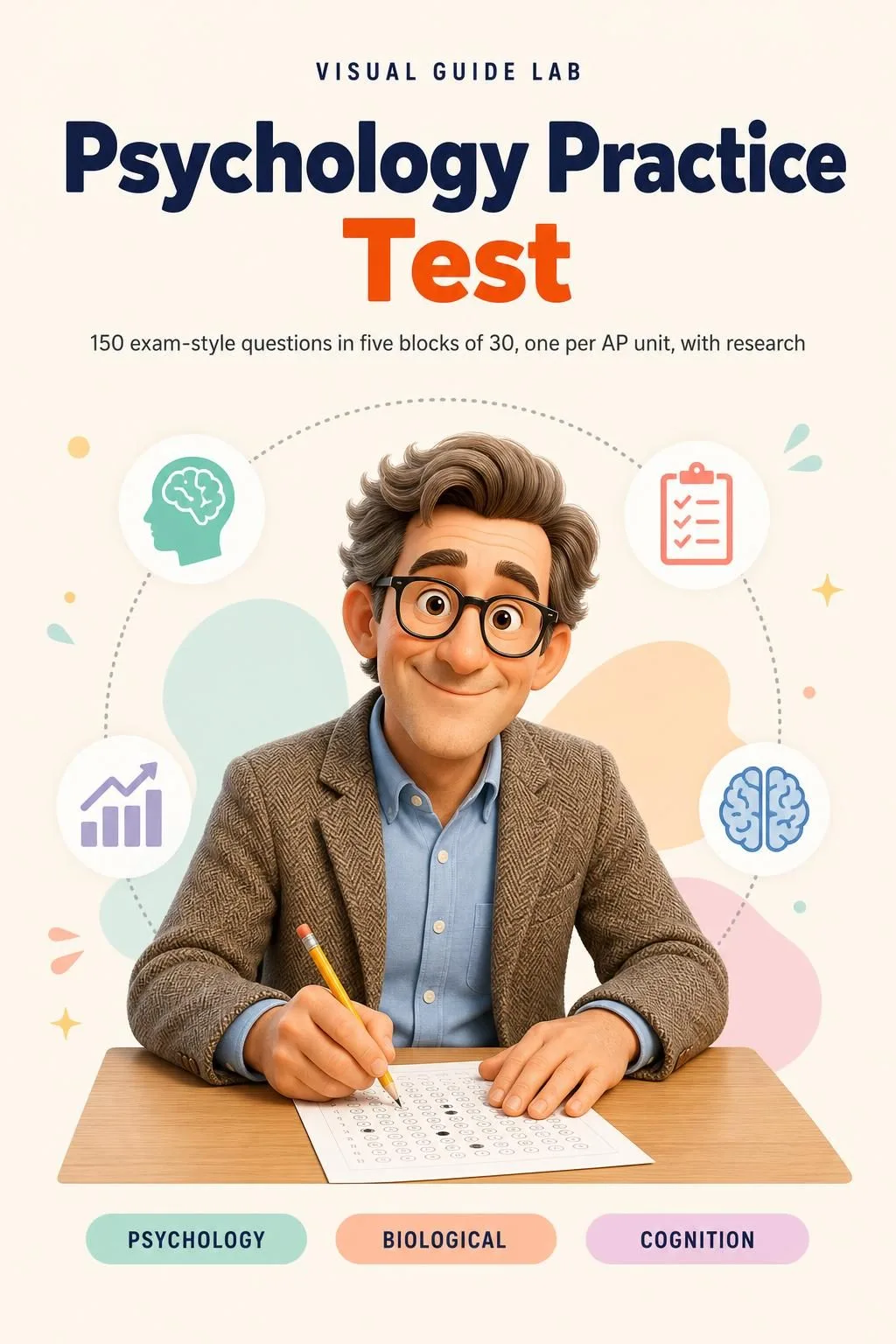
Psychology Practice Test

BONUS 1: «Psychology Practice Test»

Value on its own: US$ 17.90

150 exam-style questions in five blocks of 30, one per AP unit, with research and data questions in every block. An answer sheet to print and an answer key with one line on why, plus what to review if you missed it. Written for this book, not official exam questions.

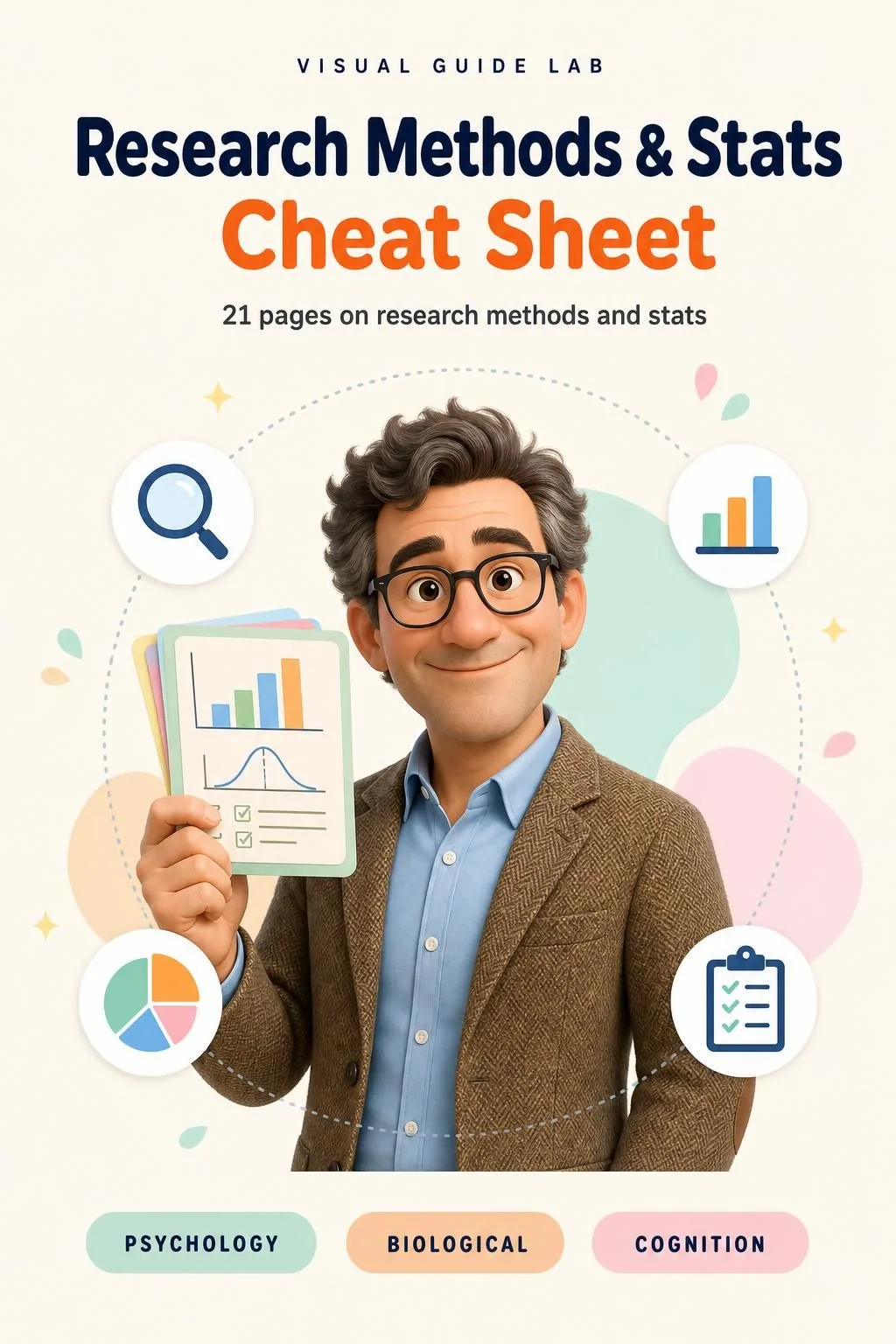
Research Methods & Stats Cheat Sheet

BONUS 2: «Research Methods & Stats Cheat Sheet»

Value on its own: US$ 14.90

21 pages on research methods and stats: variables and designs, samples and controls, mean and standard deviation, the normal curve, z-scores, correlation, significance and ethics, with worked examples and the two free-response questions.

Psychology Made Visual + 2 Free Books

  • Psychology Made Visual: 82 illustrated pagesUS$ 63
  • BONUS 1: Psychology Practice TestUS$ 17.90
  • BONUS 2: Research Methods & Stats Cheat SheetUS$ 14.90
  • High-resolution PDF to printIncluded
Total value US$ 95.80
YOUR PRICE:
US$ 27
You save US$ 68.80
YES, I WANT PSYCHOLOGY MADE VISUAL FOR US$ 27

📄 This is a digital PDF book sent to your email: nothing is printed or shipped.

Secure purchaseEncrypted payment30-day guarantee

PDF by email: Psychology Made Visual reaches your inbox as a PDF, and the two free books come by email too. One-time payment, no installments or hidden costs.

Is This Book for You?

You are taking AP® Psychology

You are taking AP® Psychology

Five units and a lot of terms. Each idea on one illustrated page you can come back to before the exam.

You are in Intro to Psychology

You are in Intro to Psychology

The core of a college intro course: the brain, memory, development, social psychology and disorders.

Your exam is coming up

Your exam is coming up

150 practice questions in five blocks and a last-minute page with the 12 pairs students mix up.
To Sum Up: Here Is What You Get

US$ 95.80US$ 27
YES, I WANT PSYCHOLOGY MADE VISUAL FOR US$ 27

📄 This is a digital PDF book sent to your email: nothing is printed or shipped.

30DAYS
GUARANTEE

30-Day Guarantee

30-day guarantee: tell us what didn't work and we'll refund 100%.

You have 30 days to try Psychology Made Visual and the two free books. If a file doesn't open, if the content isn't what this page describes, if you were charged twice or the download never arrived, write to us and we'll refund you in full. One payment, no subscription, no surprises.

Frequently Asked Questions

How do I get the material?

You get it by email, at the address you enter at checkout: Psychology Made Visual as a high-resolution PDF, to read on your phone or print. The same email brings the two bonus books, Psychology Practice Test and Research Methods & Stats Cheat Sheet. If you want it in your kid's inbox, just forward it.

Is it a monthly or a one-time payment?

A one-time payment of $27 for the book and both bonus books. At checkout you'll see optional add-ons: you only pay for them if you check them. No installments and no subscription.

Who is it for?

For high school students taking AP® Psychology, college students taking Intro to Psychology (including adults going back to school for a prerequisite) and parents, homeschool parents included, who want a clear explanation to study alongside their kids. It's written at high school and college level: the drawings are labeled diagrams, grids and curves, not children's illustrations. It's a study and review guide, not a full curriculum. Check the table of contents above to see every topic.

What sources is it based on?

On the AP® Psychology Course and Exam Description (College Board, revised for 2024-25), cross-checked with the APA Introductory Psychology Initiative learning outcomes and, for disorders, the DSM-5-TR (American Psychiatric Association, 2022).

Is it official material?

No. It's an independent illustrated study guide that follows the five units of the redesigned AP® Psychology course (2024-25), not the older nine-unit version. AP® is a registered trademark of the College Board, which is not affiliated with and does not endorse this product. The 150 practice questions were written for this book; they are not official exam questions.

Does it replace my textbook or my class?

No. It's for understanding and reviewing what you see in class. Disorders are described for study, not for diagnosis.

Is it only for AP® students?

No. The topics are the core of a college Intro to Psychology course too. A few college topics outside the AP® framework are not covered in depth.

Are the practice questions from the real exam?

No. They're written for this book in exam style, to help you practice. They're not official questions from any exam.

Can I print it?

Yes. It's a PDF, so nothing is shipped on paper: you print it yourself, one page at a time or the whole book, or read it on a phone, tablet or computer.

What if I don't like it?

You have 30 days: if a file doesn't open, if the content isn't what this page describes, if you were charged twice or the download never arrived, write to us and we'll refund you.

One Last Thing Before You Decide...

You don't have to reread the same page hoping it sticks this time.

You don't have to memorize theories you can't picture.

And you definitely don't have to walk into the exam not knowing where to start.

There's an easier way. And it's one click away. Now it's your turn.

One-time payment: US$ 27 · Guarantee: 30 days · PDF by email

YES, I WANT PSYCHOLOGY MADE VISUAL FOR US$ 27

📄 This is a digital PDF book sent to your email: nothing is printed or shipped.